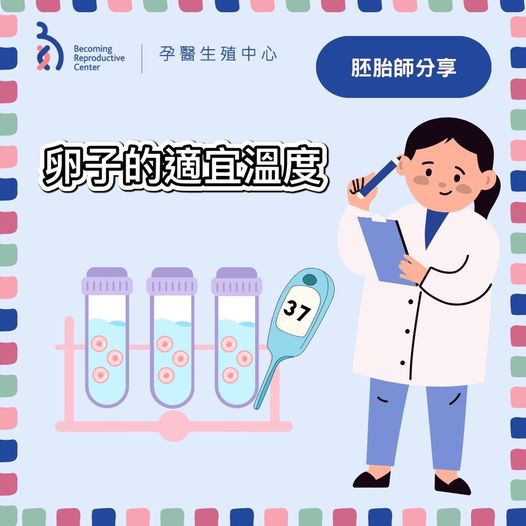
The Appropriate Temperature for Eggs
The appropriate temperature after egg retrieval ❄️
BRCIVF senior embryologist Bi-Fang Wei shares:
We know that the human body maintains a constant temperature, usually around 37°C.
The ovaries are located deep inside the body cavity and provide eggs with a stable, constant-temperature environment.
When eggs are retrieved through a procedure, we must provide the 37°C environment that eggs need.
Therefore, all containers and materials used during egg transfer, such as egg collection tubes, flushing solution, culture medium, and culture dishes, must be preheated in a 37°C warming device.
The incubator temperature is also set at 37°C.
For microscopic observation, a heated glass stage is used to keep the culture dish at 37°C.
The laboratory also regularly uses precise instruments to monitor, maintain, and calibrate these temperature-controlled devices, ensuring the accuracy of the 37°C environment.
#The temperature for egg cryopreservation ⛄️
The history of egg cryopreservation began later than sperm cryopreservation, which started in 1953, and embryo cryopreservation, which started in 1978.
It was not until 1986 that the first pregnancy after thawing a cryopreserved egg was reported.
Because the egg is the largest single cell in the human body, water inside the cell can form ice crystals during the freezing process, causing irreversible damage to the egg cell.
With the invention of vitrification, this technique has become the preferred method for freezing.
After high-concentration cryoprotectants and the cells reach equilibrium over a certain period of time, the cell volume can decrease by 30–50% due to dehydration.
The egg is then placed into a freezing carrier and directly immersed in liquid nitrogen, allowing the cell to vitrify instantly.
This prevents ice crystals from forming inside the cell in time, reducing damage caused by intracellular freezing.
After the freezing process is completed, the prepared eggs are transferred into liquid nitrogen tanks at -196°C for storage.
At this extremely low temperature, the eggs enter a state of dormancy.
Learn more about egg freezing:
https://www.brcivf.com/ec99/IVF/category.asp?category_id=16
BRCIVF wishes your dreams come true!